AI RED TEAMING
Find the failures before your users
Most enterprise AI systems are tested with a limited set of manual cases. BeyondGuard runs thousands of adversarial attacks against your LLM applications, agents, RAG pipelines, and tool workflows before users, attackers, or auditors find the failure first.
The attack surface expanded faster than teams can map
Enterprise AI systems now expose more entry points than manual review can track. Most teams are still catching up.
Manual red teaming doesn't scale
A team of researchers can find the obvious failures. They can't run ten thousand attack variants against every release.
Automated adversarial testing is the new standard
An attacker model generates thousands of prompts. A judge model evaluates every response. The output is a quantitative measure of where the system fails — before any user discovers it.
THE JUDGE MODEL
The judge is the same model that runs in production
Many automated red teaming tools use a generic LLM as the judge. BeyondGuard uses the same fine-tuned classifier logic that protects production systems, so testing results translate directly into runtime security decisions.
The gap other tools ignore
Generic LLM as judge. Different training, different sensitivities, different failure modes than your production system. A jailbreak it flags might pass clean through your live filter. The findings report measures what one stock model thinks, not what your system will actually catch.
Generic LLM as judge
Different model in test vs. prod
Static findings report
Measures one stock model's opinion
How we close it?
The red teaming judge is the production classifier. A finding from testing is a finding your runtime layer would have caught. A pass translates directly to your live defence. And attack patterns discovered during testing feed back into continuous retraining, the test layer and the run layer get smarter together.
Fine-tuned production classifier as judge
Same model, no gap
Attack patterns feed back into retraining
Measures what your live system catches
BENEFITS
What you get back
FINDINGS
An actionable findings list, not just a score.
Every failure surfaces with the prompt that triggered it, the response that constituted the failure, the judge's reasoning, and the risk category it belongs to. Findings are ranked by severity, so your security team knows where to start.
EVIDENCE
A defensible
audit trail
Every campaign generates a full record of what was tested, what was found, what was remediated, and what remains. The documentation regulators now expect for AI in regulated industries, produced as a byproduct of running the test.
FRAMEWORKS
Findings mapped to the frameworks that matter.
Every finding maps to the specific control or requirement it relates to in the major AI security frameworks. So when audit time comes, the work is already done.
OWASP LLM Top 10
NIST AI RMF
MITRE ATLAS
EU AI Act
GDPR · KVKK
CLOSED LOOP
A defence that gets
sharper between tests.
The judge model that scores attacks during testing is the same fine-tuned classifier that protects your system in production. Every finding from a red teaming campaign retrains that classifier. The next campaign starts smarter than the last. So does your live defence.
Where Red Teaming Fits in the BeyondGuard Platform
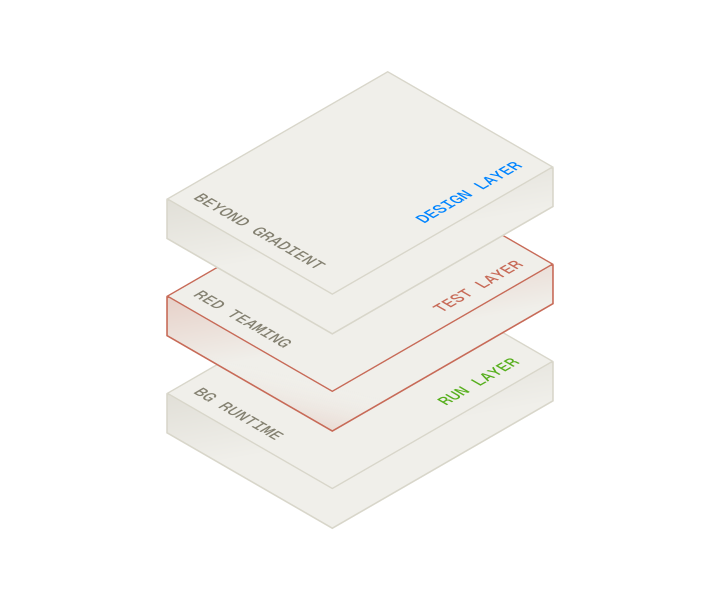
Beyond Guard secures the full lifecycle of enterprise AI: design, test, and run. Red Teaming is the test layer. Beyond Gradient is the design layer, hardening prompts and validating system instructions before they reach production. The Beyond Guard runtime platform is the run layer, the AI proxy that inspects and enforces every interaction once your AI is live.
The three layers share the same security model and the same fine-tuned classification engine. A vulnerability surfaced in Red Teaming is a vulnerability the runtime layer would catch. A prompt that passes Beyond Gradient's verification has been checked against the same rules Red Teaming will exercise. Each stage informs the next. The lifecycle isn't three separate products. It's three views of one control plane.
Design Layer
Test Layer
Run Layer